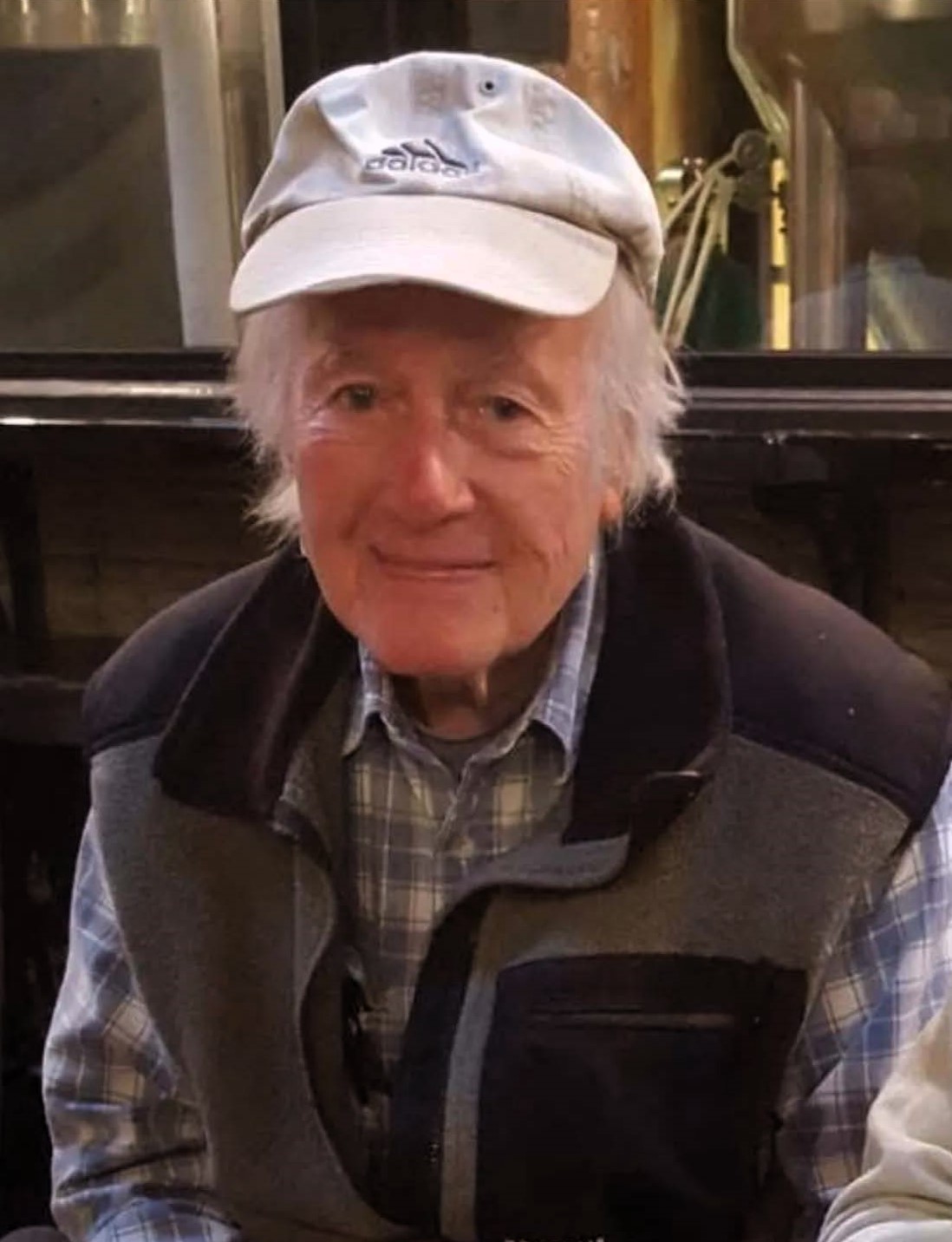
 Scott Atwood Mabusth (May 5, 1931 – January 6, 2026) passed away peacefully at his home in Long Lake, Minnesota, surrounded by family. Scott was a lifelong inventor and computer technology pioneer whose career spanned the earliest era of punch-card computing through the rise of interactive interfaces. Known for his curiosity, ingenuity, and determination to make technology more human-friendly, he dedicated his life to building and advancing systems that helped people interact with information in more intuitive ways. Scott was born on May 5, 1931, in the rural town of Cokato, Wright County, Minnesota, to Arthur S. Mabusth and Adelle A. Mabusth. When he was 12, his family moved to Greensboro, North Carolina, where a defining spark was lit when his father brought home a radio salvaged from a Russian tank, and Scott became captivated by electronics. He spent countless hours learning how electronic signals moved, how circuits behaved, and how devices could be repaired and improved. He learned wherever he could and often lingered at a wholesale electronics store in Greensboro where staff shared their knowledge freely. He also found a mentor in the neighborhood who was a ham radio operator and spent evenings learning how radios were built and operated. At 15, Scott’s parents moved to Winston-Salem, but Scott stayed behind in Greensboro for several months, living at the YMCA while he decided what to do next. He ultimately rejoined his family and soon found work at Western Electric in the accounting department, where he worked with IBM punch-card equipment. Even as a teenager, Scott was drawn to the logic and mechanics behind the machines. He configured punch-card operations, debugged mechanical issues, and watched closely when IBM technicians performed maintenance. He was fascinated by relay-based systems that were laying the groundwork for a new age of computing. He worked at Western Electric for two years, up to age 17. Drafted into the United States Air Force at 18, Scott was stationed at Wright-Patterson Air Force Base in Dayton, Ohio. He pursued assignments involving IBM punch-card systems—training civilians on the equipment and wiring new punch-card boards to support new applications. After two years, the Air Force acquired a new Univac system and selected Scott for six months of specialized training to perform hardware maintenance on the new architecture, which used vacuum tubes and magnetic tape storage. His training took him to New York and Philadelphia, and while in Philadelphia, Scott studied machine-language programming with Admiral Grace Hopper. Returning to Wright-Patterson, he became a true “jack-of-all-trades,” maintaining and troubleshooting both Univac and IBM systems at a time when the field was still being invented.After completing his military service at age 22, Scott returned to Minnesota and accepted a job with Univac in Minneapolis as a programmer. He spent his early years working on the Burlington Northern project implementing an accounting system, and he later advanced to lead programming teams delivering projects for many different companies. During this chapter of his life, he met Jeanne Andrea Gallagher—first in 1956 and again in 1957—and they were married in 1957 in New York City. Their partnership became the steady foundation for a life filled with family, innovation, and shared purpose. Scott’s wife Jeanne was the bedrock of the family, and she dearly loved and admired her husband. She was key in supporting all the years of Scott’s technical innovations and the companies he started that represented his lifelong accomplishments. She was there during the best of times and the most difficult of times, always supporting Scott at every step. Scott and Jeanne’s deep love and friendship for each other was the cornerstone of their lives together. Scott stepped away from Univac for a time to study at the University of Minnesota under the veteran’s assistance program, pursuing a college degree. After approximately two years, he returned to Univac as a software development manager, spending a total of nine years with the company. During those years, the Mabusth family lived primarily in Minneapolis, with a period in Lake Forest, Illinois, when Scott served as regional manager for the Eastern region before returning to Minneapolis to manage in the Midwest. Scott and Jeanne eventually made their home in Long Lake and later Medina (Morningside), where they raised their family. Around 1965, Scott joined Control Data Corporation (CDC) as a sales representative. Based out of the Golden Valley office near Highway 100 and Highway 12, Scott managed major accounts including the University of Minnesota, working across the medical school, atomic laboratory department, and university administration. During this time, he helped support major computing installations, including work associated with the first Cray supercomputer installation at the University of Minnesota. While at CDC, Scott gained early exposure to touch-driven terminal concepts and medical computing consoles. Ideas that would ultimately shape the next phase of his life’s work. The early touch approach used a large antenna/plate behind the terminal and sensed touch through the glass that was effective for large displays, but difficult to scale as devices became smaller. Scott was deeply involved in presenting and marketing these ideas at data processing and technology conferences, and he carried forward both the promise and the limitations of early touch interfaces. In 1969, Scott left CDC and founded his first company, Bionics Inc., in Minneapolis. According to Scott’s notes and family records, he pursued early work on touch-driven management information system (MIS) interfaces and developed concepts that evolved into a touch-based system for the Red Owl project. Family records describe development and pilot activity through 1969–1972, with the system becoming operational in 1973. In March 1973, Scott formed Information Dialogs in Minnesota (MN File 2G-145). Through the 1970s and into the early 1980s, he continued to build and commercialize touch-sensitive technology and related software in the Minneapolis metro area under the Information Dialogs / IDI umbrella. These were years defined by hands-on invention, refinement, and real-world product development. By the early 1980s, Scott’s work advanced into a new chapter. Around 1981 he began what would become Volks Communications, and the company was incorporated in Minnesota on August 4, 1982 (MN File 4E-152). Scott’s work reached a defining milestone in 1985 with his patent US4550221 (“Touch sensitive control device”), which describes a capacitive touch sensor using interleaved conductive plates arranged in rows and columns. A touch from a finger changes the local capacitance, and the system scans (multiplexes) the grid to compute the X–Y location of the touch on the surface. In plain terms, it laid out a practical way to turn a flat surface into an accurate touch input device that reliably detected where a person touched without mechanical switches. The approach helped establish core techniques for row/column capacitive sensing and scanning that are foundational to many modern capacitive touch interfaces (touchpads and touchscreens) used today. The patent’s influence is reflected in how often it is referenced in later touch sensitive innovations. Google Patents lists 425 later patent publications that cite US4550221 as prior art. Those citing patents include filings from recognizable technology companies—such as Apple, IBM, Synaptics, and others—showing that Scott’s work became part of the documented foundation that current touch-interface inventions were built upon. Outside of work, Scott found his greatest joy at home and being outdoors. He and Jeanne built a life on their three-acre property on North Brown Road in Long Lake. A place Scott loved to tend, improve, and quietly observe. He took special delight in the natural world around him, watching animals on the property and faithfully feeding the birds, often pausing simply to take in what he saw. Scott was also an avid photographer. He captured countless moments of family life over the years, along with the wildlife that visited the property, preserving memories with the same careful attention and appreciation that he brought to everything he did. Among many of Scott’s endearing traits, he had an amazing sense of humor. He would often wake up in the morning after dreaming up some hilarious joke, or some funny scenario or situation that always left his family in stitches. His humor was very creative and often a bit bawdy as well. He was sometimes asked to stand up at company parties and tell jokes about the company or coworkers that were always entertaining. That gift of humor didn’t stop with him and lives on in his children and grandchildren. His sense of humor even lasted up until his final days. He was a natural problem-solver with a deep love for mechanics. Someone who could fix virtually anything that broke. If a part was needed, Scott would find it, patiently searching through catalogs and finding exactly what was required. His determination and ingenuity were legendary within the family and there was rarely a problem he couldn’t diagnose, a device he couldn’t repair, or a solution he couldn’t devise. Scott also had a lifelong affection for sports cars. He especially loved a classic MG from his youth and a Jaguar MK2 that he purchased in 1965 as he was beginning family life with Jeanne. Cars that reflected his appreciation for design, craftsmanship, and the joy of the road. Music was another enduring passion. Scott loved many styles including jazz, R&B, and rock and roll. He attended countless concerts over the years with his family. He took real pride in the musical interests of his children and grandchildren and especially enjoyed hearing the bands they performed in. Scott was also an amazing dancer with his own style of movement that was uniquely his own. He would typically start grooving when the mood hit him, and his body moved in a style some might say inspired by James Brown. But above all else, Scott most loved being at home and spending time with his “best friend,” Jeanne, and welcoming visits from his children and grandchildren over the many years of his life. Scott is survived by his beloved wife of many decades, Jeanne Andrea Mabusth (Gallagher); his children John Mabusth, Scott Mabusth Jr. (Marianne), Stuart Mabusth (Mary), and Lee Mabusth (Mike Mayasich); his grandchildren Brittany Laine Mason, Patrick Mabusth (Kaitlyn), Kate Vitolo (Marc), Jared Mabusth, Nolan Mabusth (Cassie Meyer), and Drew Mabusth (Nick Benish); and his great-grandchildren Harper, Ingrid, Carter, Maverick, Sadie, Jay, JoAnn, and Mari. Scott was preceded in death by his parents, Arthur and Adelle Mabusth; his brother Robert Mabusth; his sisters Audrey Mabusth and Joyce Mabusth; and his grandparents John J. Mabusth and Sarah Mabusth. Scott’s life was defined by a rare combination of technical brilliance and hands-on practicality and craftsmanship. An inventor who never stopped learning, building, testing, and improving. His legacy lives on in his wife Jeanne and the family he so dearly loved, the people he mentored and collaborated with, and the technologies he helped bring into the world! A service and celebration of life will be scheduled in Spring of 2026 when Scott’s family and friends can celebrate his life in the warmth that he shared with everyone around him. Arrangements by Swanson-Peterson Funeral Home & Cremation Services. Swansonpeterson.com 320 286 2534.
Jan
22